AI SEO Strategy for a B2C SaaS: $234.36K MRR & 4M+ Users
Important Note: This deep dive covers my work with Rezi from January 2024 to December 2025.
I joined Rezi as the editorial and content manager at the very start of 2024. We built organic search, making it the company’s top acquisition channel. What follows is the story of how we adapted our SEO and content strategy for AI search and LLMs, the thinking behind the decisions, the frameworks we built, and what the data tells us about where this is heading.
How I thought about the AI search shift
In May 2023, Google launched Search Generative Experience. By May 2024, AI overviews were live. I'd been thinking and planning for this well before launch, but the underlying thesis stayed consistent throughout:
In a search environment where AI answers your queries no matter how specific they are, the brand that gets cited wins. The goal was to make Rezi show up when someone asks an LLM questions like, "What should I use?" or "What actually works?"
Winning in the age of AI search is about making sure your brand shows up in LLMs and that your product is being talked about in the right way. If you're not controlling that narrative, someone else will.
This wasn't about completely reinventing SEO. It was about raising the content quality bar, focusing on what actually differentiates us, and showcasing clear product use cases.
In practice, that meant:
Prioritizing content for high-intent queries that AI systems and users are more likely to trust, cite, and recommend
Adjusting how we structure content so it's more scannable and readable for both humans and LLMs
Shifting effort away from content for informational intent and focusing more on intent in the middle and bottom of the funnel
Making execution more scalable without lowering editorial standards
Here’s how that played out.
“AI-proofing” our content
One of the first things we did was "AI-proof" our top blog articles. This meant making them more valuable and making sure they can't easily be replicated by AI.
The standards set:
Summary-first intros: The answer upfront, easy to read, followed by deeper explanation.
Overview bullets under key H2s and H3s: Fast scannability and clearer extraction for AI.
More long-tail coverage: Specific sub-questions users actually ask, often pulled from Reddit or forums.
First-person and real examples: What we've seen, what works, what doesn't.
Product storytelling: Where Rezi fits, why it matters, how people use it.
User input: Authentic perspectives from real users, or expert commentary pulled from relevant discussions on forums like Reddit.
More visuals: Infographics, screenshots, examples, credibility elements.
We also added more original data where possible. When I was updating an article about resume fonts, I added: "We reviewed 3 million resumes built with Rezi AI. The most popular font size wasn't 10 or 12 pts as most advice says online, it was actually 9 pt." Another example: my article on "How to List Education on a Resume" included the most common qualifications from Rezi resumes.
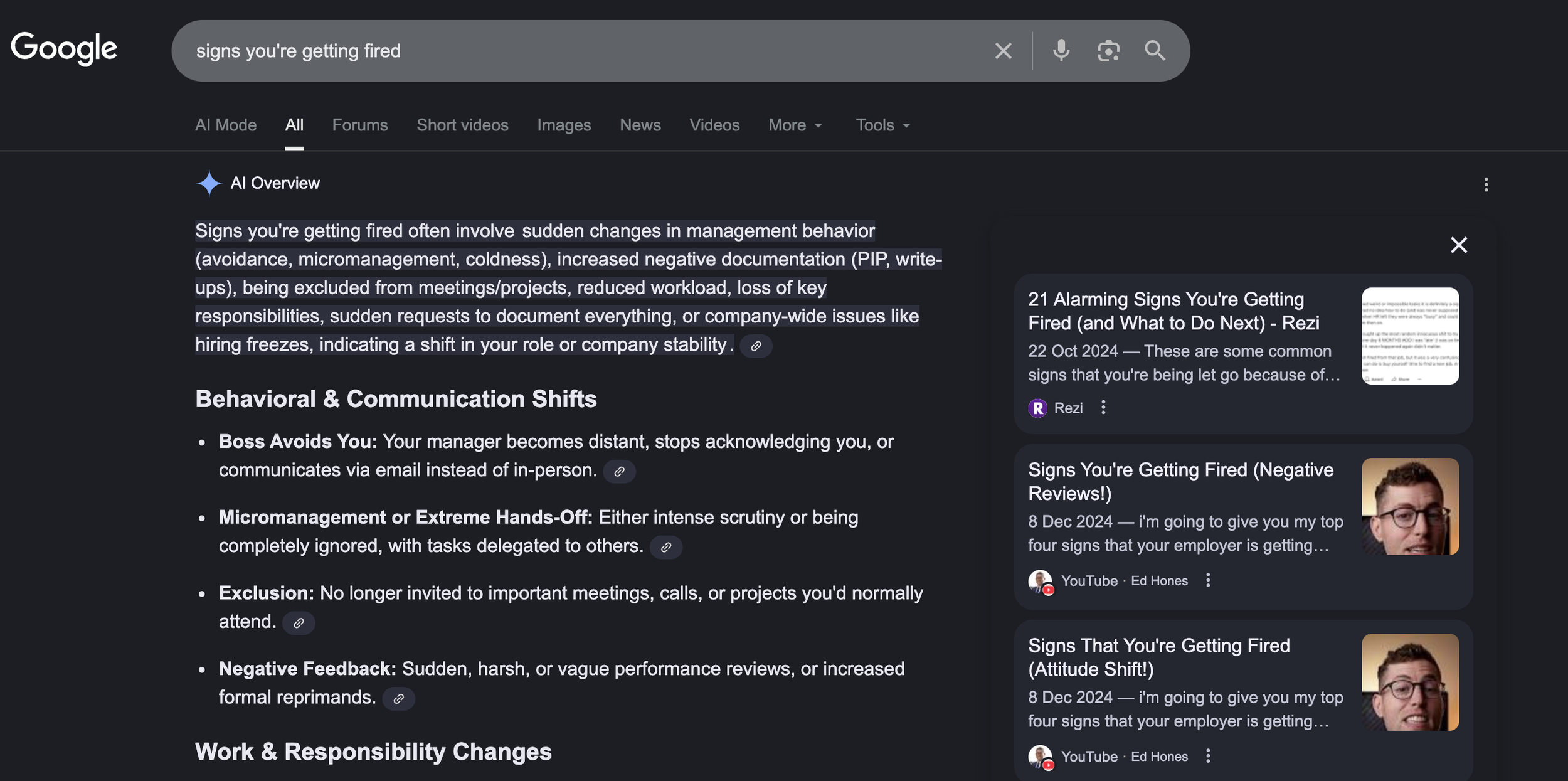
An early signal this was working: my article "Signs You're Getting Fired" ranked as the first result in AI Overviews. We began using it as the reference for AI-proofing standards, and I recorded a video walkthrough for our writers on how I approached it to help reinforce these standards across the team.
Product-led content (plus more focus on MOFU and BOFU)
I prioritized content that clearly shows when, how, and why Rezi is useful:
Product pages, user docs for feature breakdowns, and landing pages tied to real use cases
Blog articles framed around solving problems with the product for different user segments
Product listicles and comparison pages/guides
The thinking: at some point in every user's search journey, they become solution-aware. That's where we need to show up. These product-led articles also let us add our input to help the user decide, for instance, when comparing Rezi with a competitor like Enhancv, another resume builder.
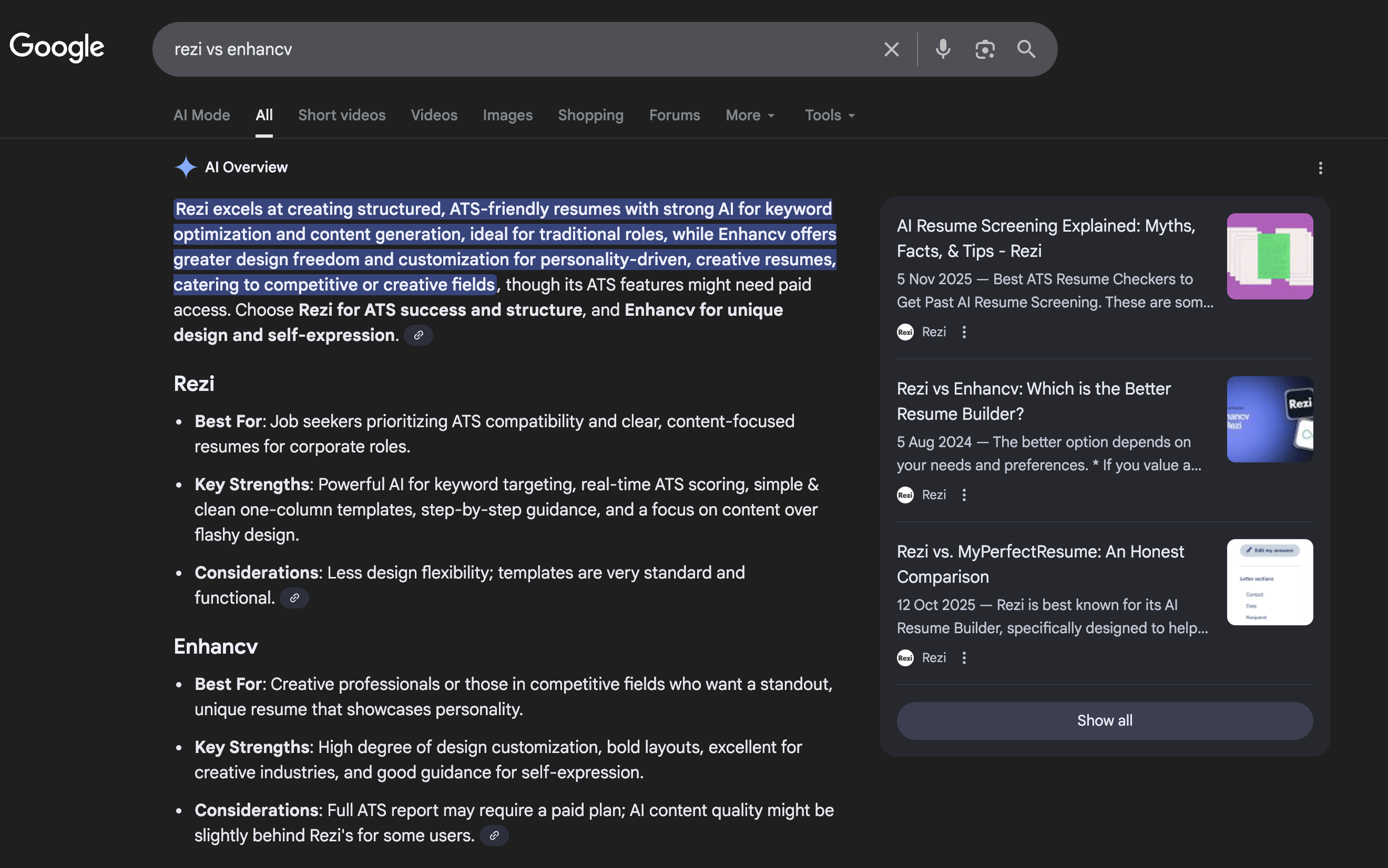
We weren't starting from scratch with these types of content, but the rise of AI search made it clear we needed to prioritize this work more heavily and raise the quality bar. We focused on answering the questions our audience asks when evaluating Rezi.
Examples:
Content grounded in personal experiences
For informational content, we doubled down on incorporating nuance that AI can't easily replicate: first-person narratives and lived experience, articles grounded in our own expertise, and contrarian or experience-based takes.
We still covered informational intent keywords, but only for the most relevant topics. We focused more on showcasing unique angles through personal experience, original data, contrarian POV, or trends. Regardless of whether AI can answer these queries directly, this content is still valuable for reinforcing topical and domain authority, as long as we offer something new to the conversation.
Examples:
Original data as a strategic lever
Original data is one of the strongest levers for earning backlinks, driving brand mentions, and supporting PR. I worked with our dev team to explore what internal data we could easily surface through user behavior trends, resume patterns, and practical insights drawn from how people use Rezi.
My takeaway — and the direction I'd push harder going forward — is that the strongest brands don't just comment on trends; they become the source of them. That means identifying the data your audience genuinely cares about, packaging insights into visuals and infographics, pairing data with expert commentary or contrarian takes, and using original insights to challenge the status quo.
One example: my article on ATS Myths. We conducted an experiment and shared original insights to challenge common assumptions — making a point that isn't typically addressed: how flawed many ATS systems actually are and how poorly some resume builders handle ATS compliance. The experiment grounded the narrative in evidence rather than opinion and reframed a conversation usually driven by surface-level advice.
Even small, focused data points when presented clearly and thoughtfully punch far above their weight.
Tool-based landing pages
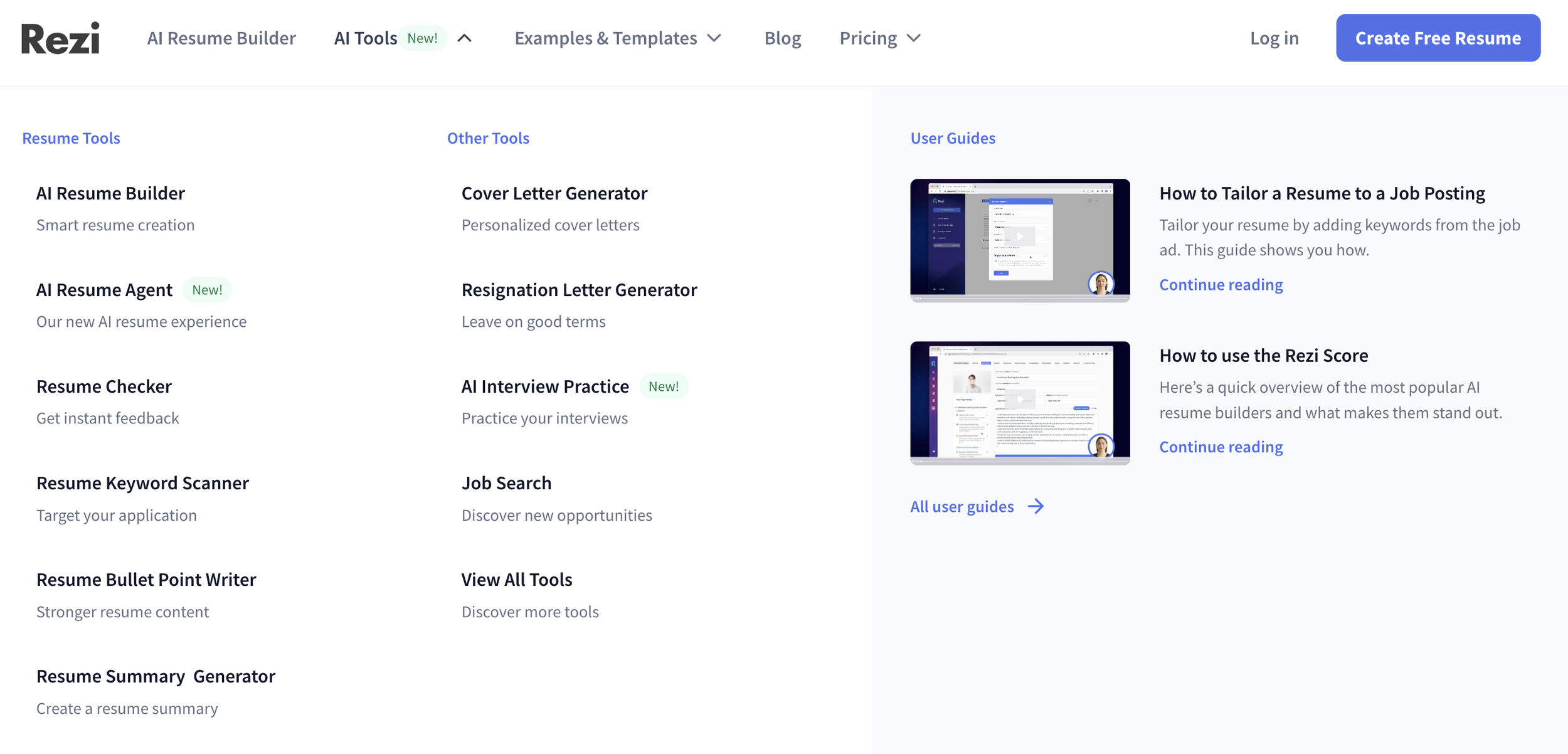
We created a dedicated tools hub at “/tools/” and restructured the site menu to surface individual tools including the resume keyword scanner, AI interview practice, and resume checker, each with its own landing page.
The logic: free tools attract high-intent users who are already in problem-solving mode. Instead of convincing someone they need a resume builder, you're meeting them while they're actively trying to improve their resume. These pages gave us targeted entry points for high-intent queries and cleaner site architecture for both users and search engines.
Trust signals
Trust and credibility signals matter more than ever for both users and for LLMs deciding what to surface and cite. Concepts like E-E-A-T had been discussed in SEO for years, so this wasn’t anything entirely new.
We focused on baking trust signals directly into the content: clearer author attribution, "edited by" indicators, stronger author bios tied to career expertise, expert and user perspectives where relevant, and more case-study-style proof. The cumulative effect mattered.
We also published supporting pages to reinforce credibility signals: editorial process and author pages, alongside bios that make our expertise in the space visible to both users and search engines.
Interestingly, around the time we rolled out the "Edited by" tab on some articles, we saw increases in keyword rankings for those pages. Hard to attribute causally, but the timing was close enough to be worth noting.
Offsite content and distribution
Brand mentions correlate with AI overviews. (Ahrefs also made a case study on this.)
That’s one reason we decided to invest in publishing articles on Forbes and getting more involved on Reddit and LinkedIn. Rezi has the largest Reddit community compared to other resume builders, something that was built years before Google SGE launched, and it's been an important factor not just to Rezi’s growth in the early days, but also for contributing to LLM visibility.
One highlight was hosting an AMA in r/SaaS. I've also personally been much more active on Reddit this past year.
Dedicated AI and LLM info page
We created a dedicated AI LLM info page. This is a structured reference page designed specifically for LLMs and AI assistants.
The thinking behind this: if AI models are going to talk about your product, you should give them the most accurate, structured information possible to work with. Instead of hoping LLMs piece together the right picture from only scattered web content, we gave them an authoritative source covering what Rezi is, who it's for, core products and features, competitive advantages, trust signals, user feedback, and media mentions.
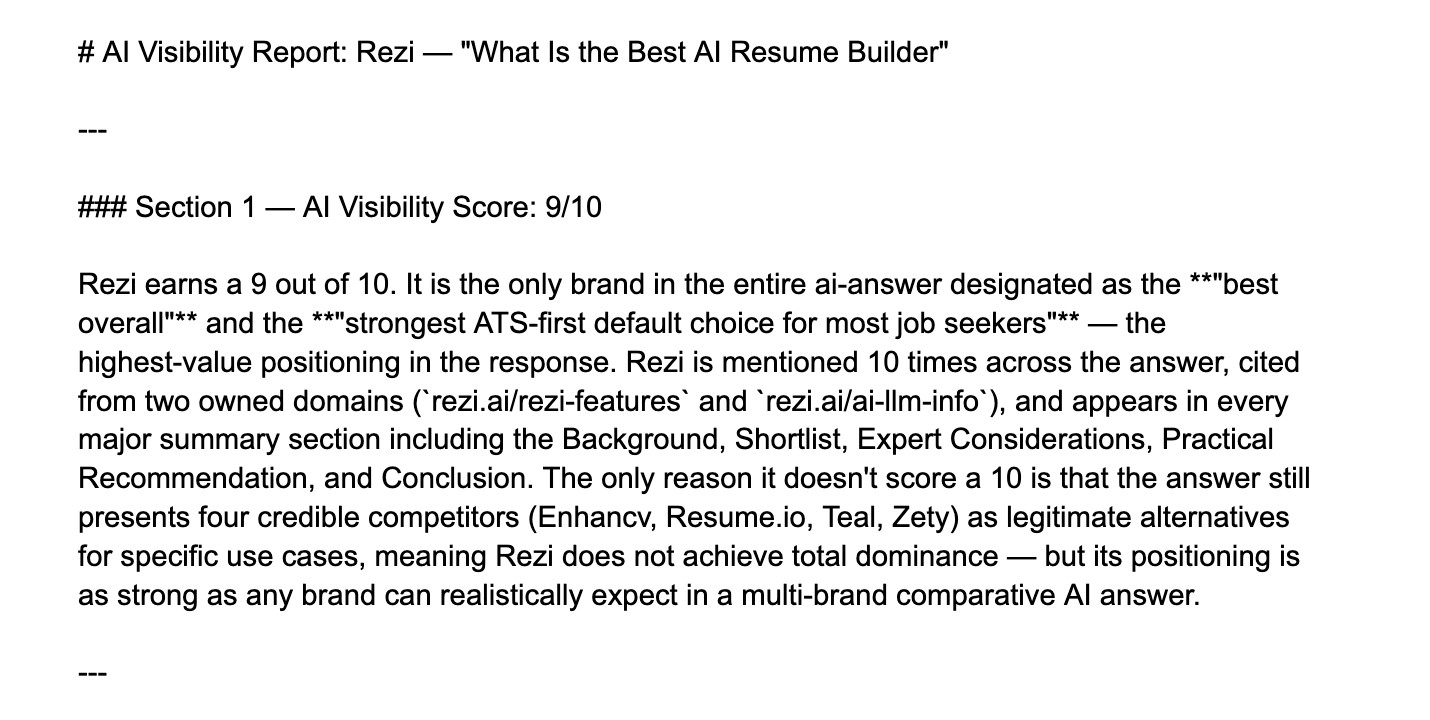
There were some signals that suggest it's working. In an AI visibility report by AirOps, Rezi scored 9/10, being the only brand positioned as the best overall and the strongest ATS-first default choice, appearing in every major section of the AI-generated answer. The LLM info page was one of two owned domains cited, as shown in the screenshot below (we’ll dive into the results in more detail later on this article).
It's essentially a brand fact sheet optimized for machine readability. We also supplemented this page with a “What is Rezi” article.
This is still a relatively new tactic, but the logic is straightforward: LLMs synthesize information from across the web to form their understanding of a brand. If you provide a clear, well-structured source of truth, you increase the likelihood that what they say about you is accurate, complete, and favorable. It's about controlling the narrative at the source level.
Content pruning and SEO health
More content isn't always the answer. We did a mass content audit on our resume examples cluster. We had thousands of individual pages for niche job titles that were difficult to maintain and likely diluting authority rather than building it. We pruned, redirected, and consolidated at scale.
This was paired with broader technical work: running audits with Screaming Frog to identify broken links, indexation gaps, and thin content. We restructured blog categories into clearer groups (Resume, Cover Letter, Career Advice, Company News), kicked off an interlinking project to strengthen topical authority and address orphan pages, and cleaned up naming inconsistencies across samples and templates to simplify things and prevent cannibalization.
We also fixed URL nomenclature issues and applied proper redirects. Less visible than publishing new content, but these improvements played a crucial role in strengthening overall SEO health.
Bringing the plan into action
Any strategy is useless if it just sits in a doc. Here’s what I did to put these things into action:
Updated editorial standards and SOPs to include AI search formatting and trust elements
Guided writers through edits and reviews to make sure AI-proofing elements were consistently applied
Identified and prioritized which existing content needed updates first
Shifted the content planning process and roadmap to prioritize product-led and conversion-aligned topics
To scale output, we experimented with AI workflows using custom GPTs. I built out programmatic content like "How to Become a [Job]" and "[Job] Resume Examples," generating first drafts that I then refined by injecting personality and adding related internal links. We also tested with an autoblogging machine for resume example clusters.
I wasn’t just “thinking about AI search.” I was making sure it refines how we actually write, plan, and ship content, plus how we approach SEO in general.
Did it work? Here were the results
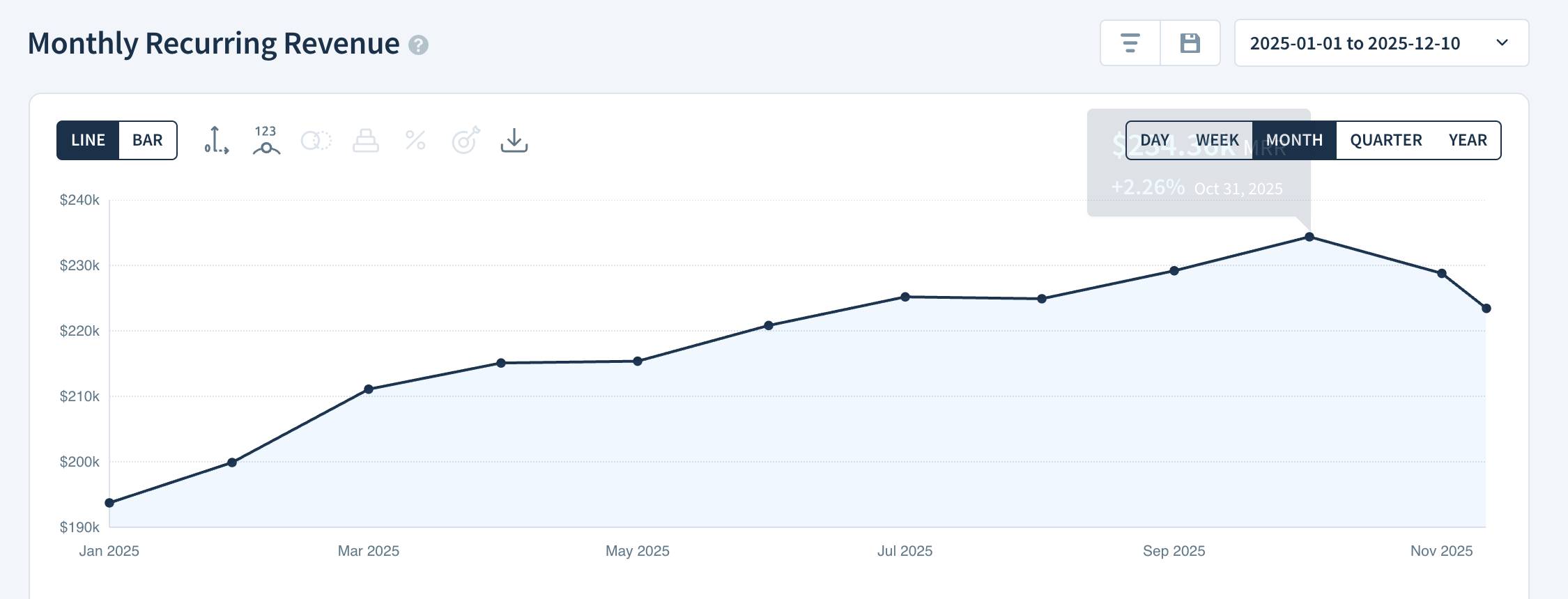
The chart below shows Rezi's monthly recurring revenue throughout 2025, with a peak just above $230K in October. While revenue is influenced by many factors beyond SEO, organic search remained our top acquisition channel.
When we compare MRR to 2024, there's clear year-over-year growth:
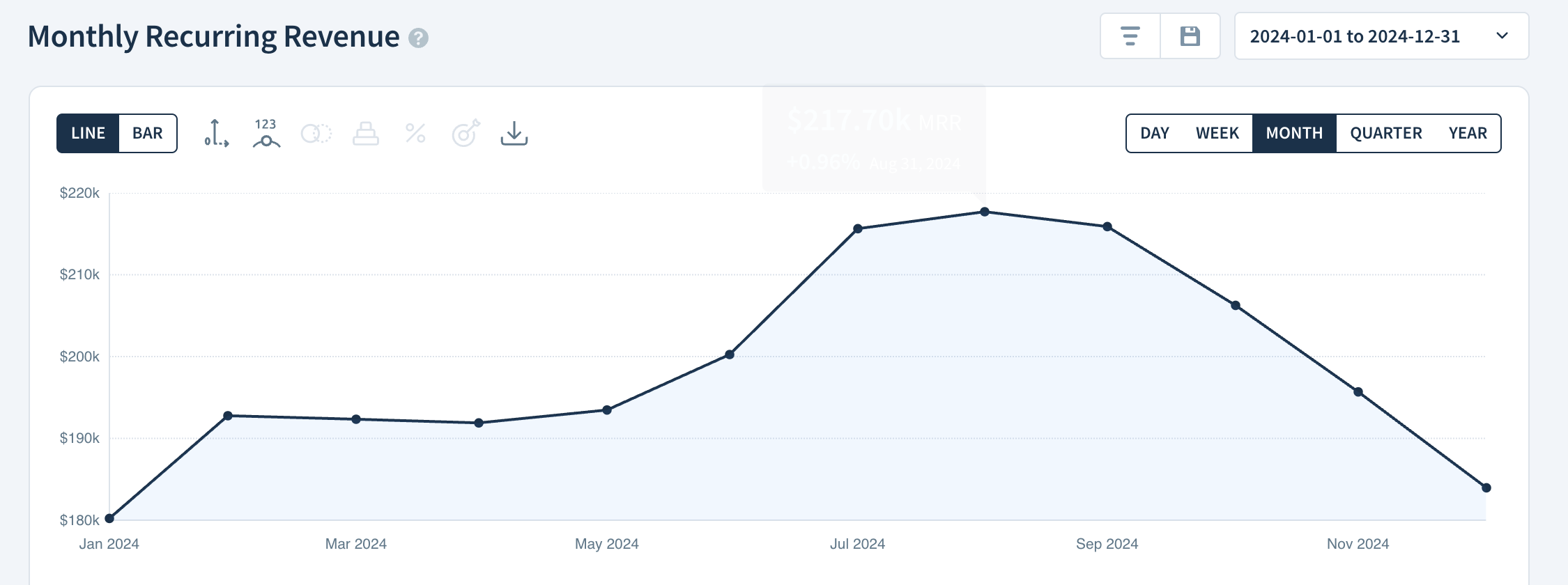
The decline in late 2024 historically aligns with seasonal trends in the job market and coincided with broader shifts in search behavior that led to reduced clicks.
Side Note: We’re very transparent on revenue figures. You can also see where Rezi is currently at on Indie Hackers.
Did organic search actually contribute to growth?
Our primary goal with organic search is to drive user signups. Throughout 2025, the Amplitude chart below shows multitouch attribution and assisted conversion paths with organic search as part of that — entry events filtered by landing pages and blog posts in US vs. non-US, alongside the free and paid user signups that followed.
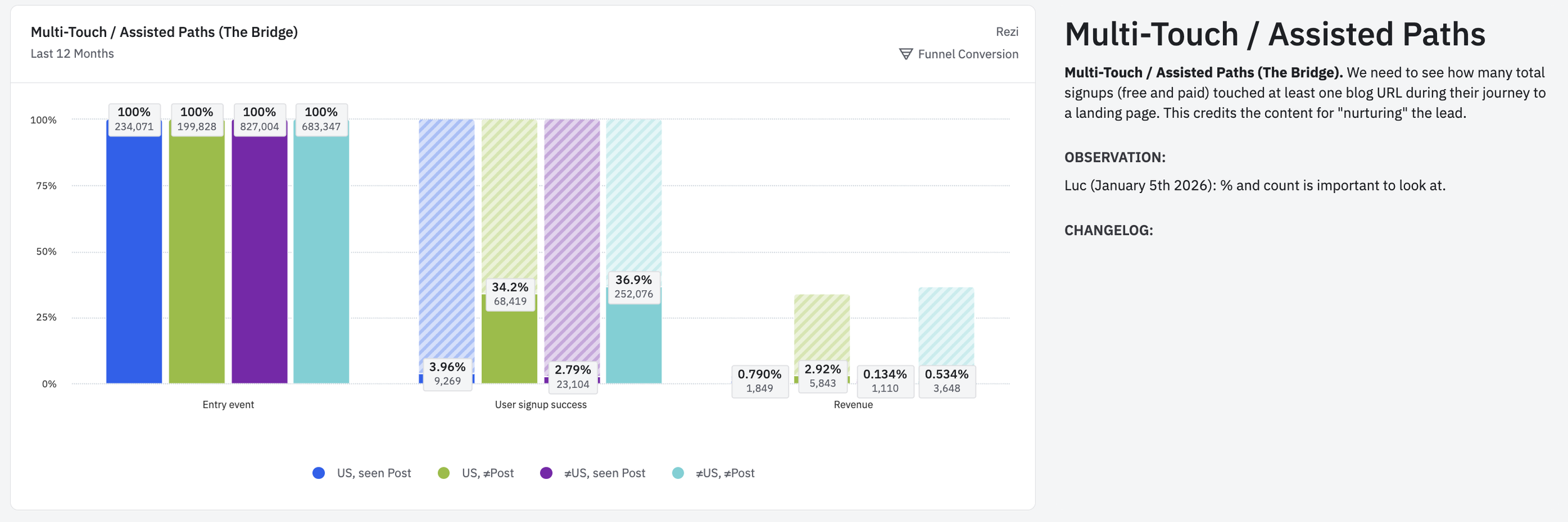
When looking at this data, it's clear organic search is driving user acquisition.
What content drove the most user signups?
There are some content pieces that drive user signups but don’t rank highly for their primary keywords, largely due to link and brand-mention gaps.
SEO shouldn’t be treated purely as a traffic channel. Rankings and impressions alone are vanity metrics, including clicks and click-through rates. When AI overviews and LLMs can directly answer a majority of search queries, it makes sense for clicks and click-through rates to drop. We're moving into a zero-click reality where the win isn't always the click.
Amplitude - top pages driving user signups (last 12 months)
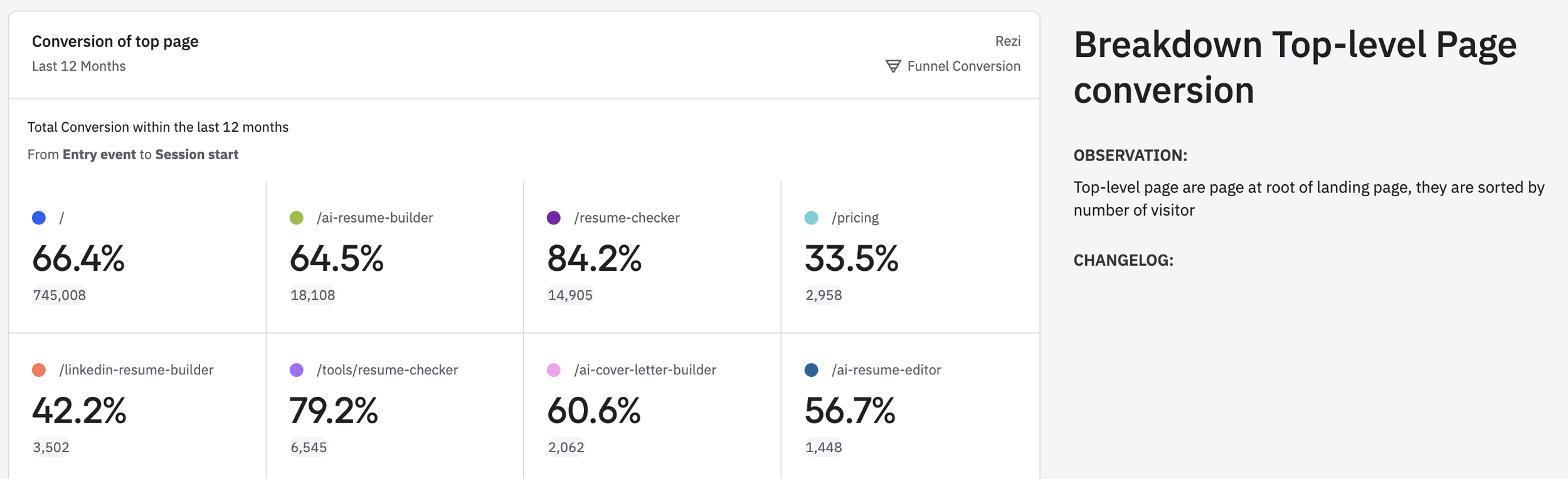
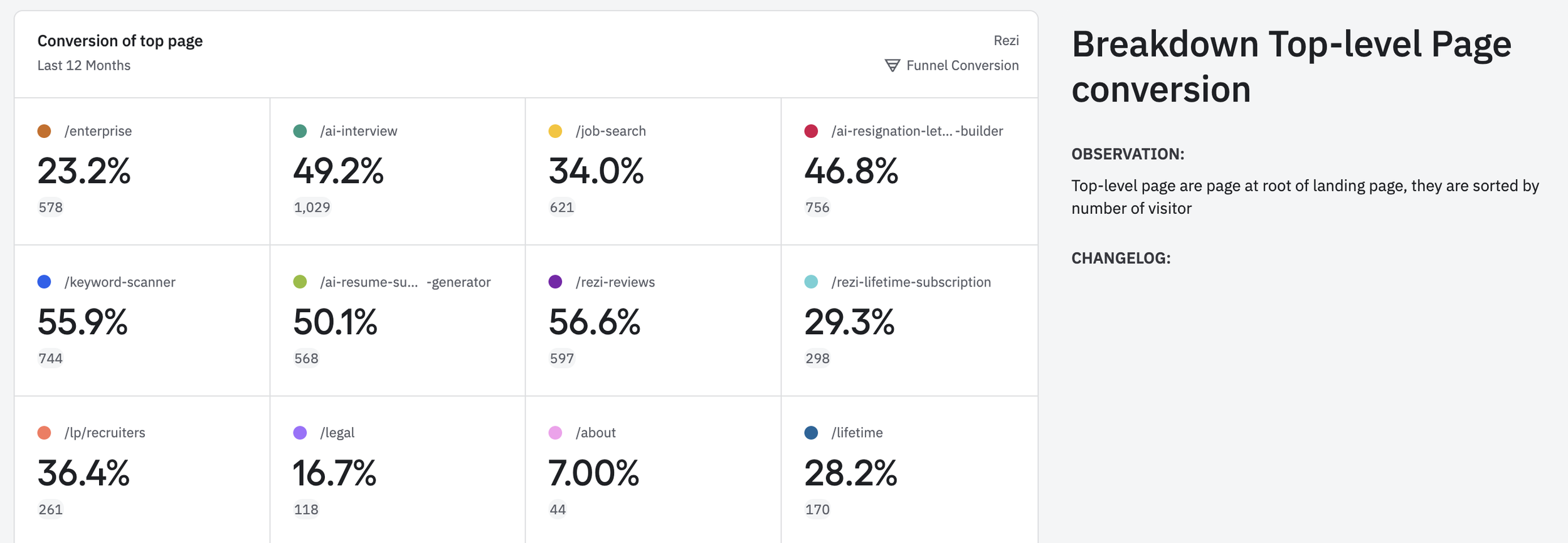
These were the pages driving the most user signups:
Amplitude - top blog posts driving user signups (last 12 months)
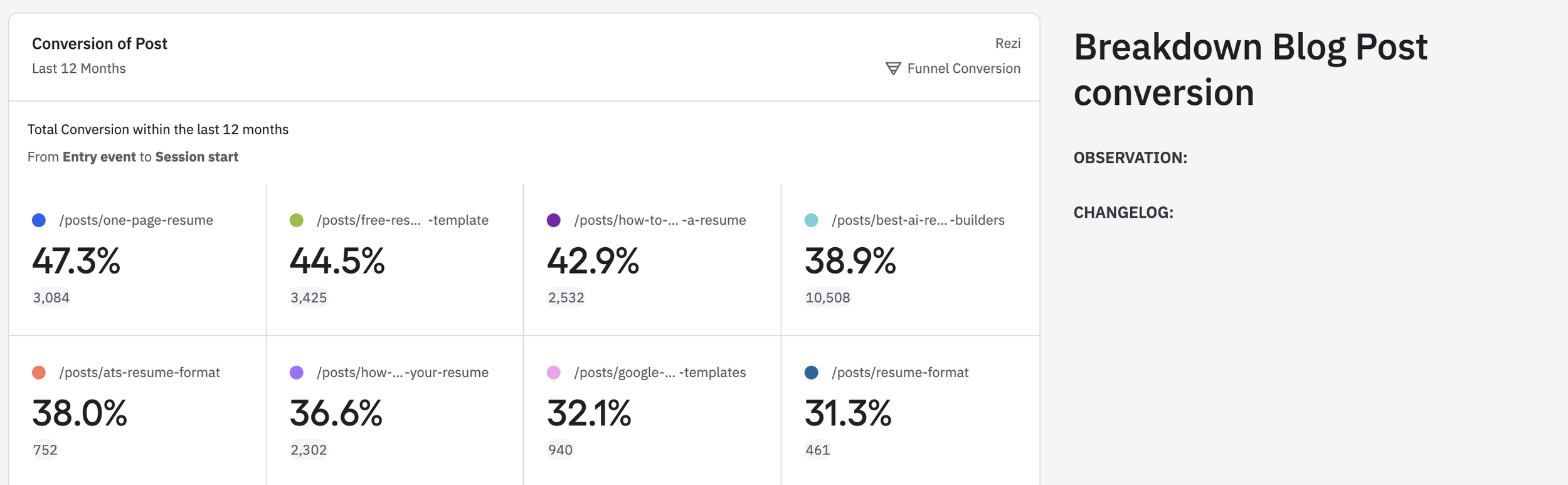
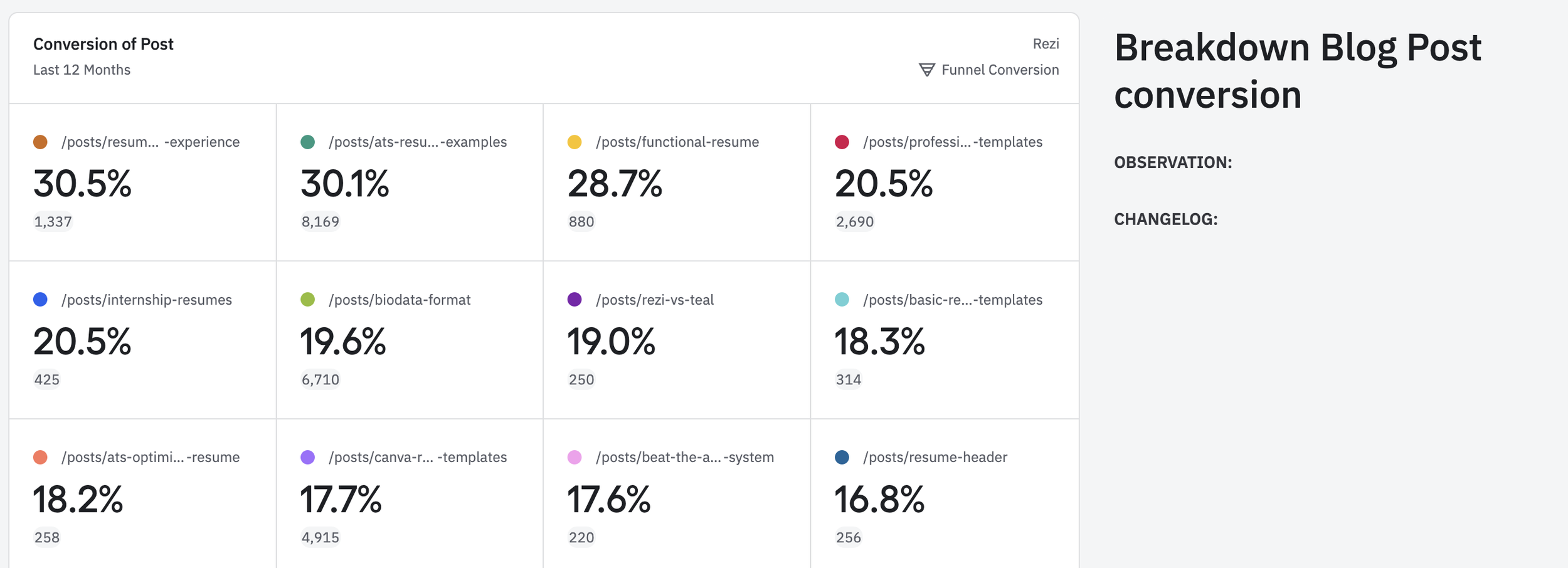
These were the blog posts driving the most user signups:
What content drove the most visibility?
These were the pages driving the most clicks and impressions for Rezi in 2025:
Rezi Google Search Console: 1st Jan 2025 to 31st Dec 2025
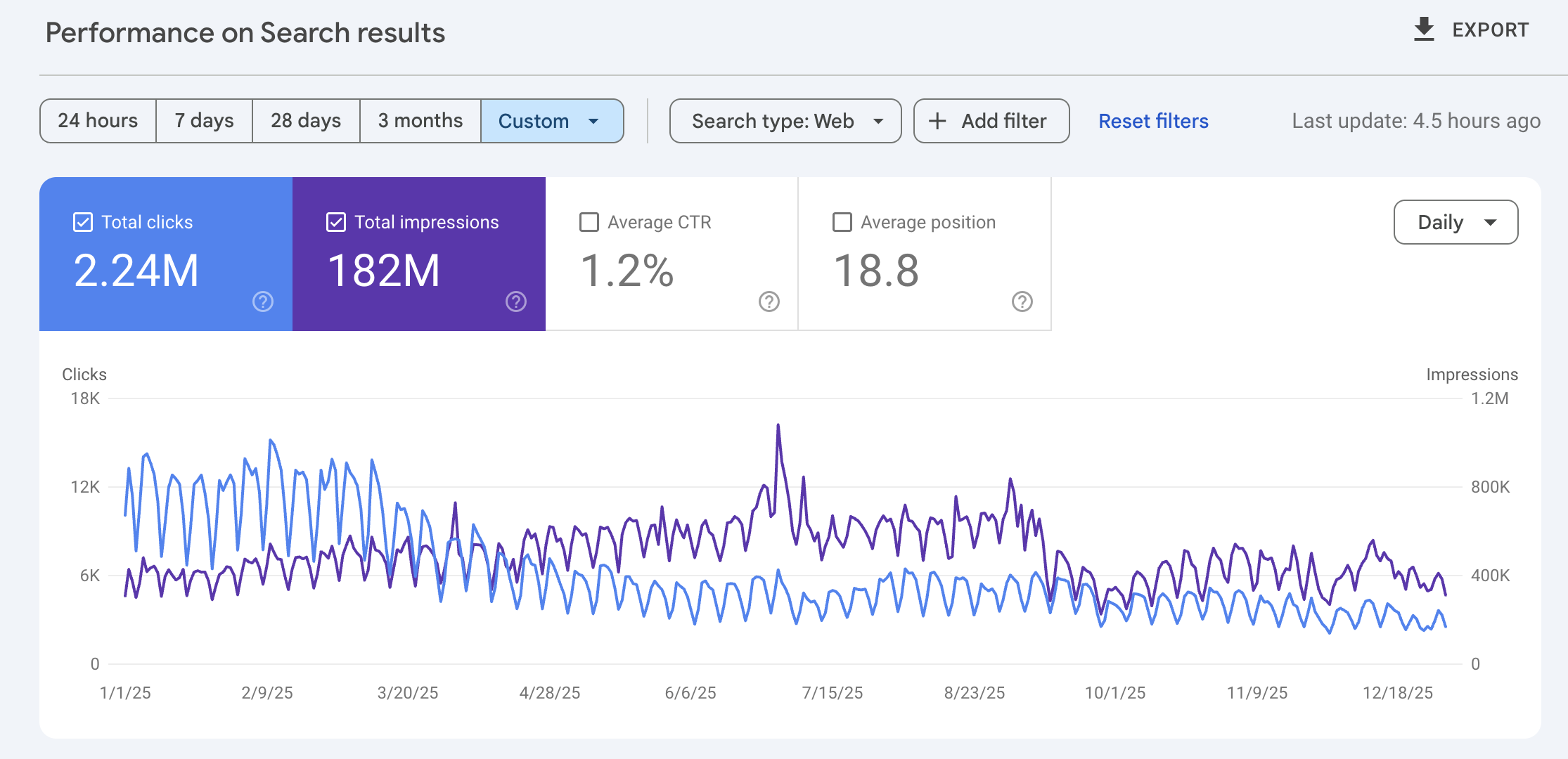
Rezi Google Search Console: 1st Jan 2025 to 31st Dec 2025 (top pages)
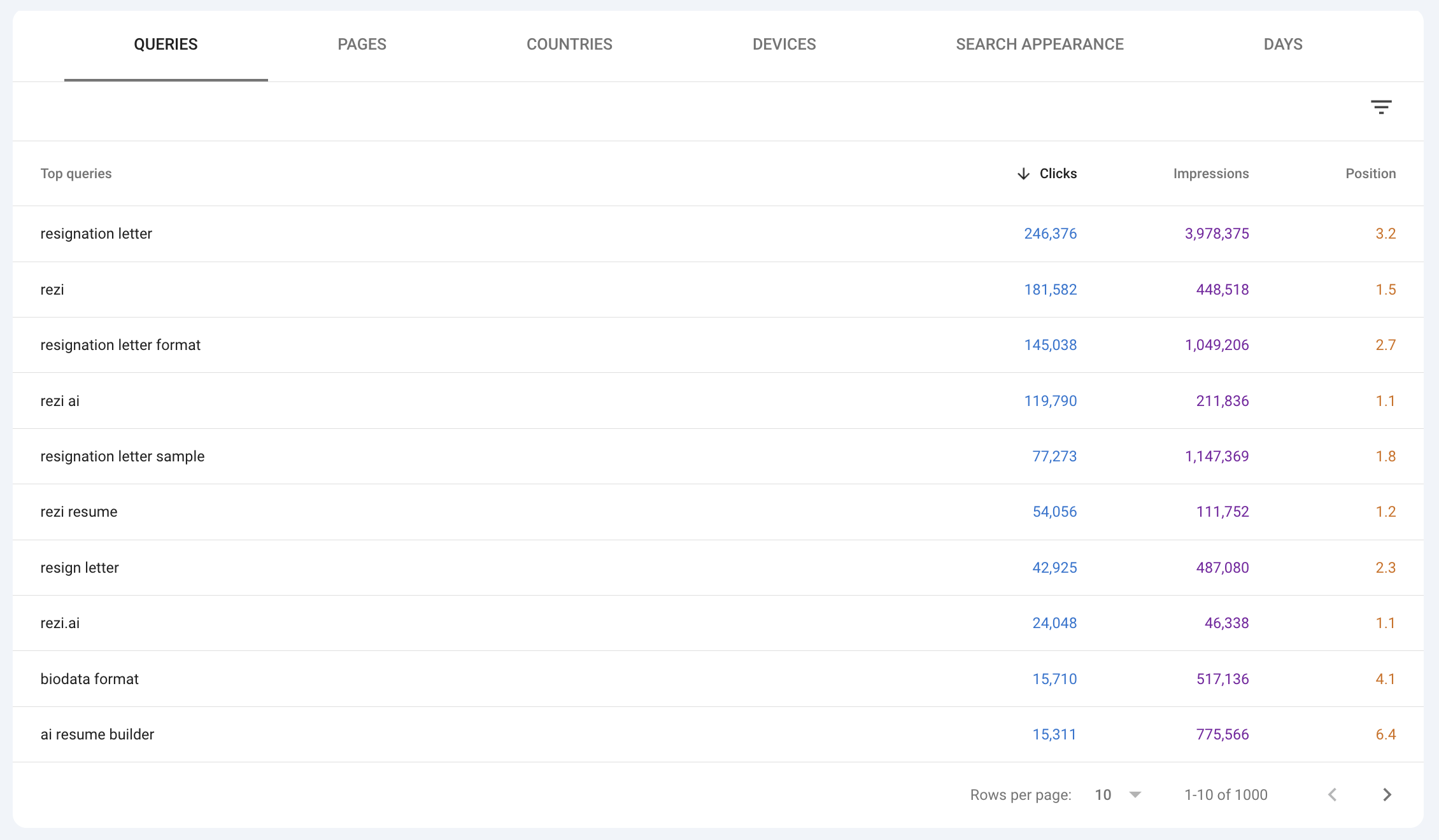
Some high-visibility pages generate significant discovery without showing a strong direct signup correlation. Content like resignation letter examples and signs you're getting fired clearly captures attention but functions more as an awareness driver.
LLM visibility
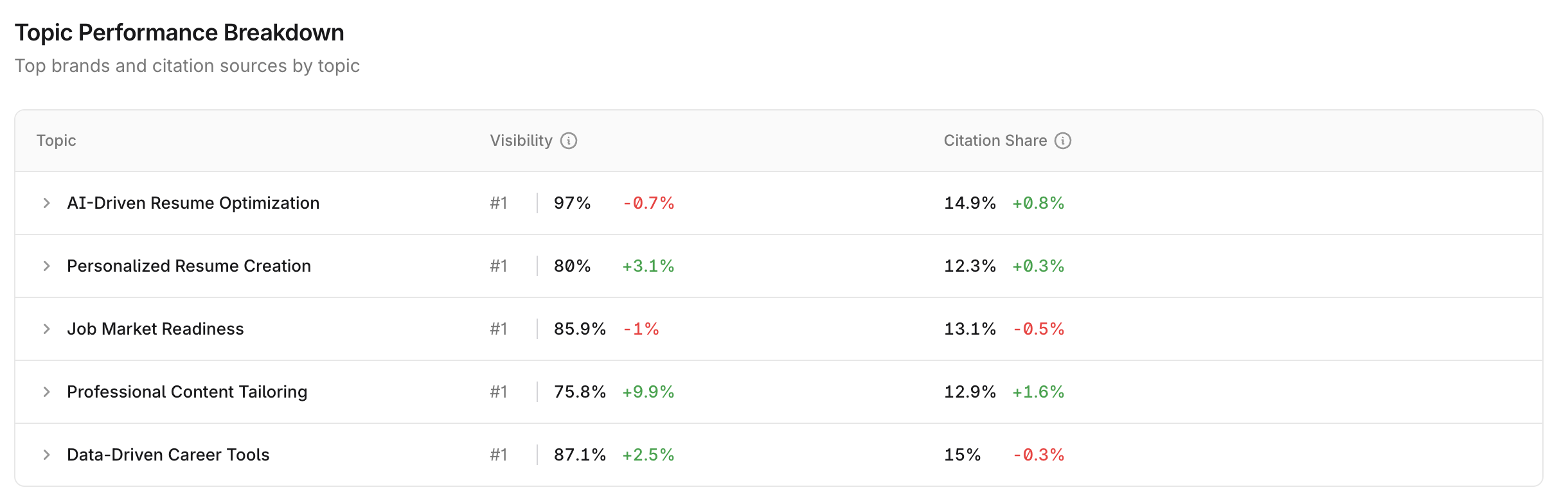
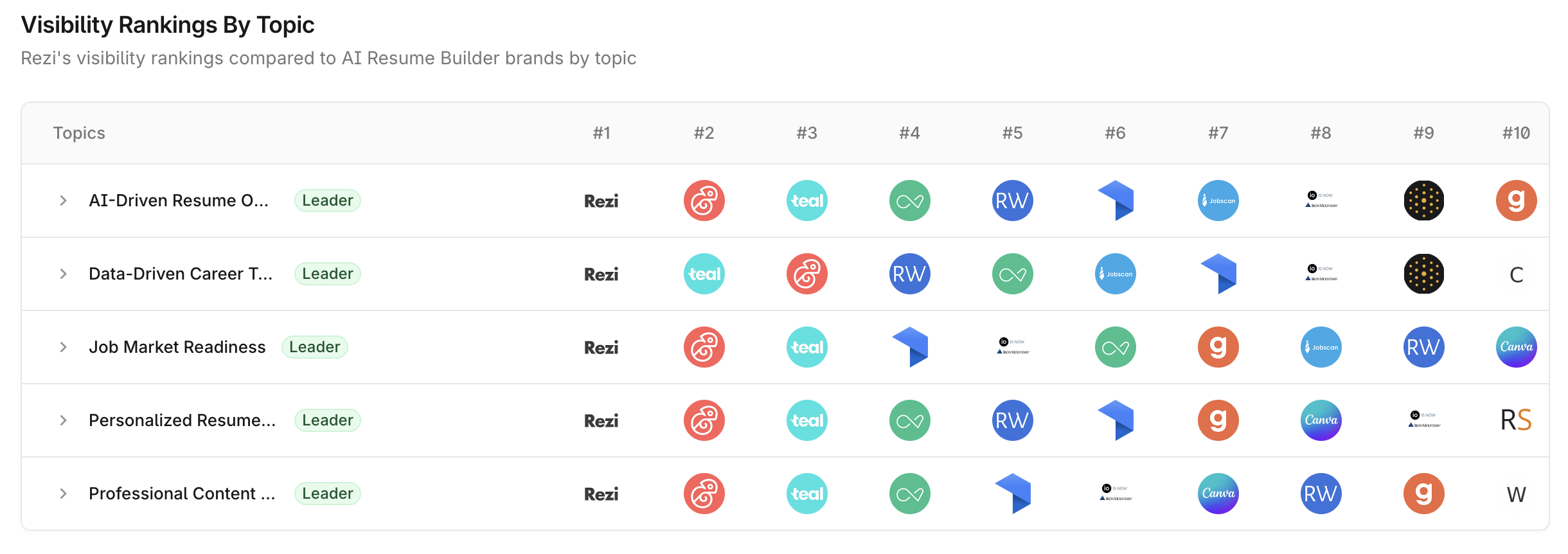
According to Profound, here were the top topics where we were most visible on LLMs:
AI-driven resume optimization (97% visibility, 14.9% citation share)
Personalized resume creation (80% visibility, 12.3% citation share)
Job market readiness (85.9% visibility, 13.1% citation share)
Professional content tailoring (75.8% visibility, 12.9% citation share)
Data-driven career tools (87.1% visibility, 15% citation share)
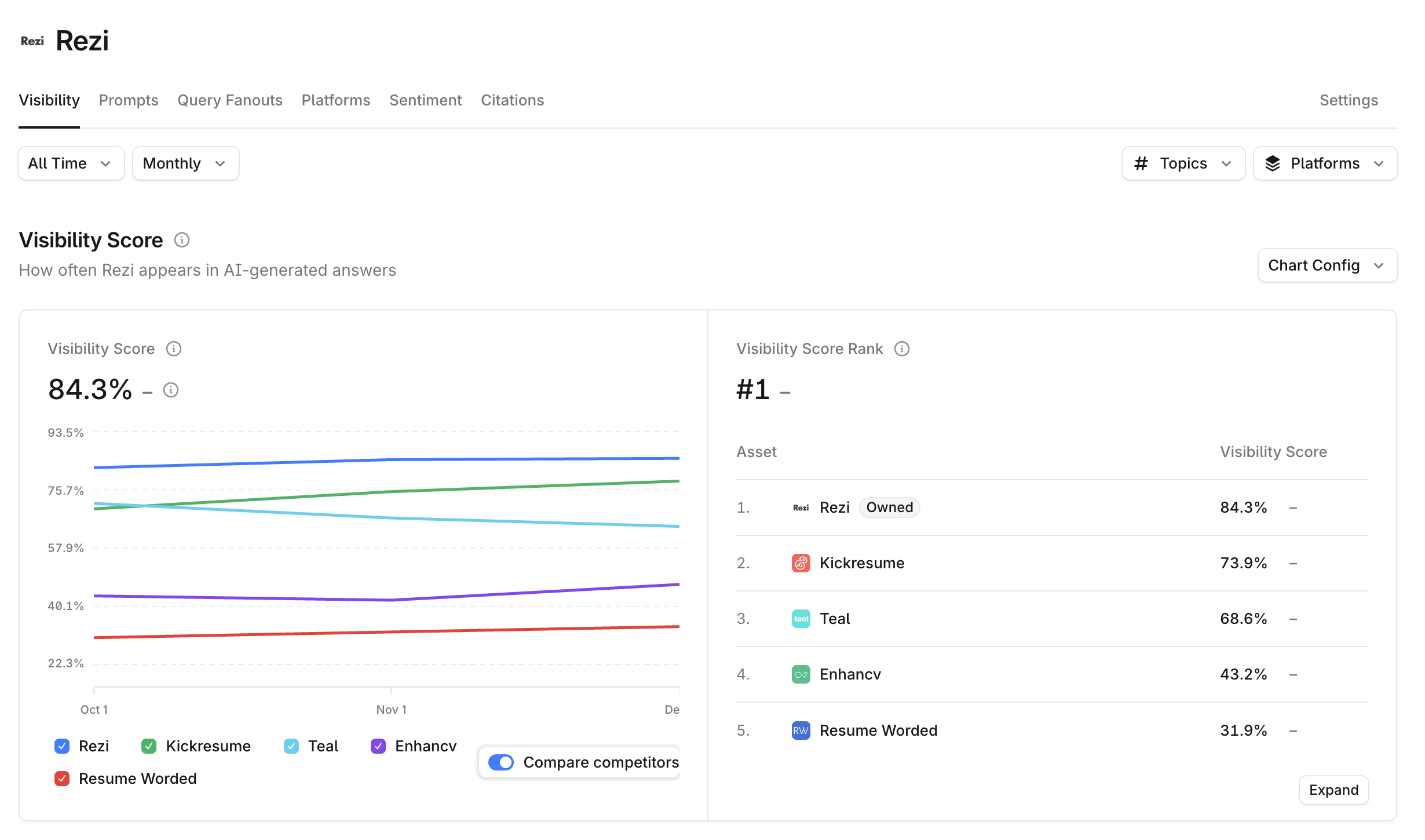
We held the #1 share of voice and the highest overall visibility score (84.3%) in AI-generated answers within these categories.
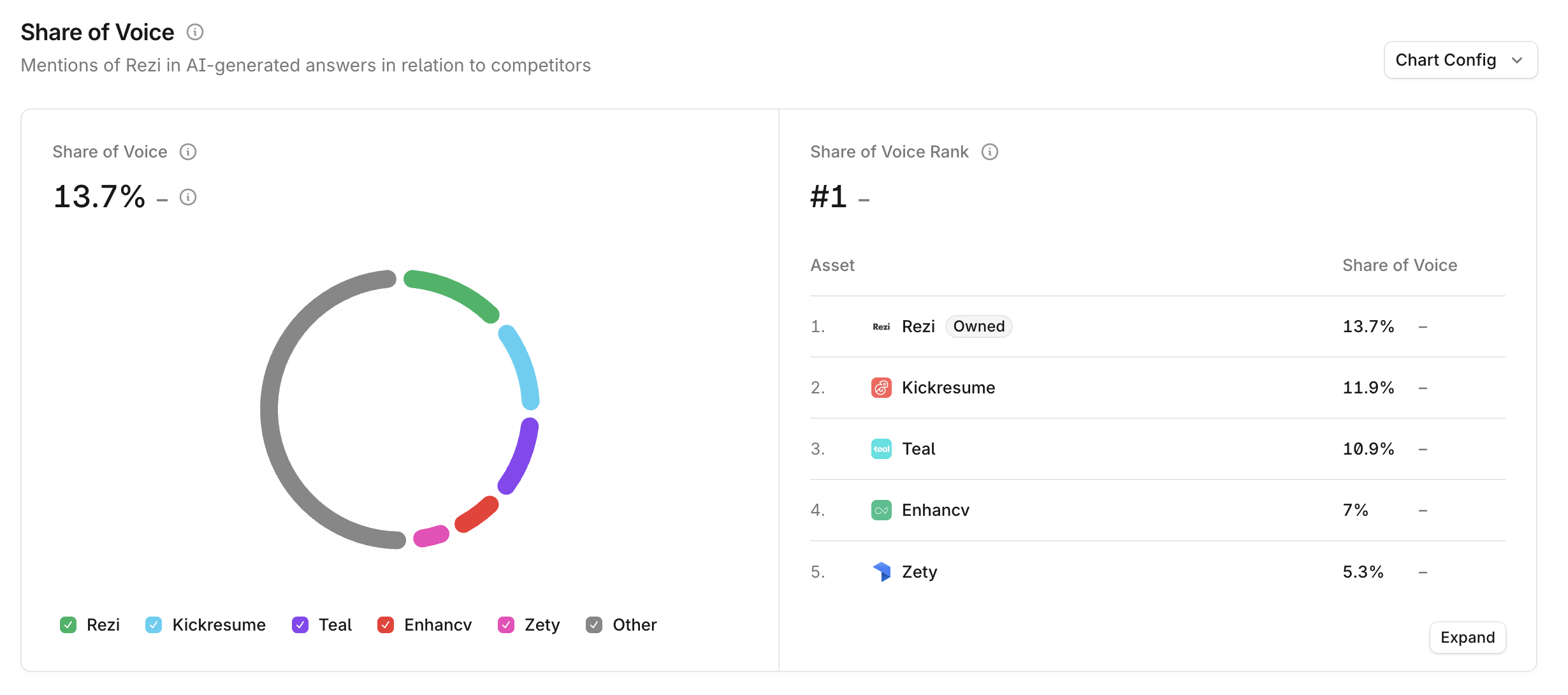
Among our closest competitors, Rezi achieved a 13.7% share of voice, followed by Kickresume at 11.9%. This indicates that LLMs are citing us as a relevant and trustworthy source.
The visualization below breaks this down by topic further, showing how Rezi compares against other resume builders across different topics.
Are people actually engaging with the content we produce?
A fair question is whether people are actually reading the content we’re putting out.
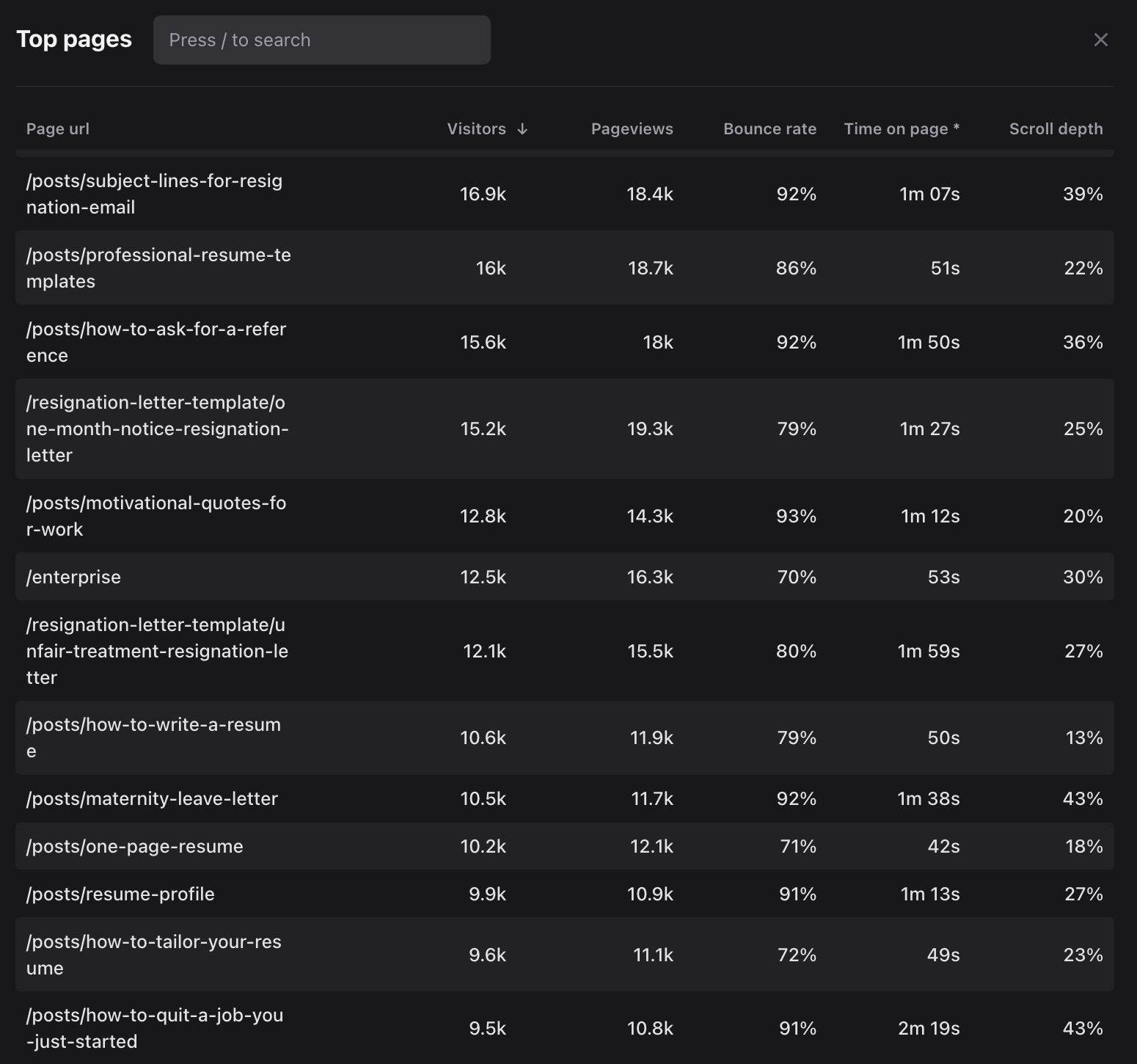
The answer is clear from the data: the content is being read, and it plays a role in user discovery and signups. Amplitude shows organic content appearing in the user signup journey. Plausible confirms organic search as a primary channel.
The Plausible screenshots below are filtered for the period of Jan 1, 2025, to Dec 31, 2025.
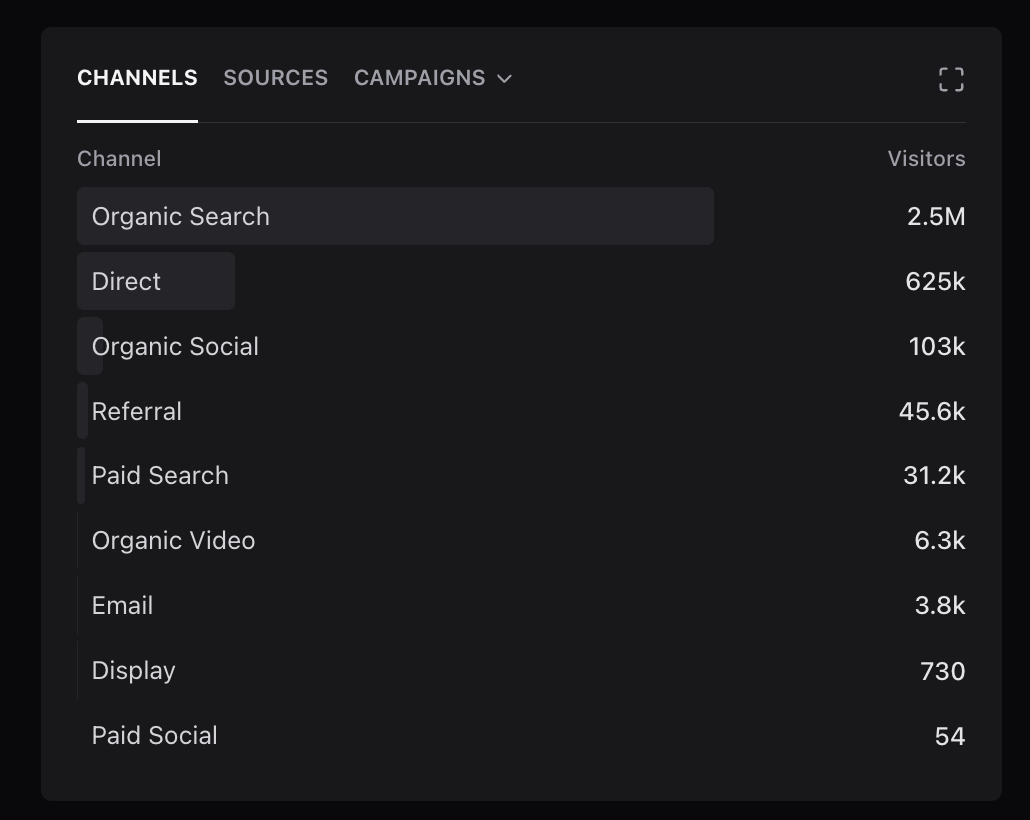
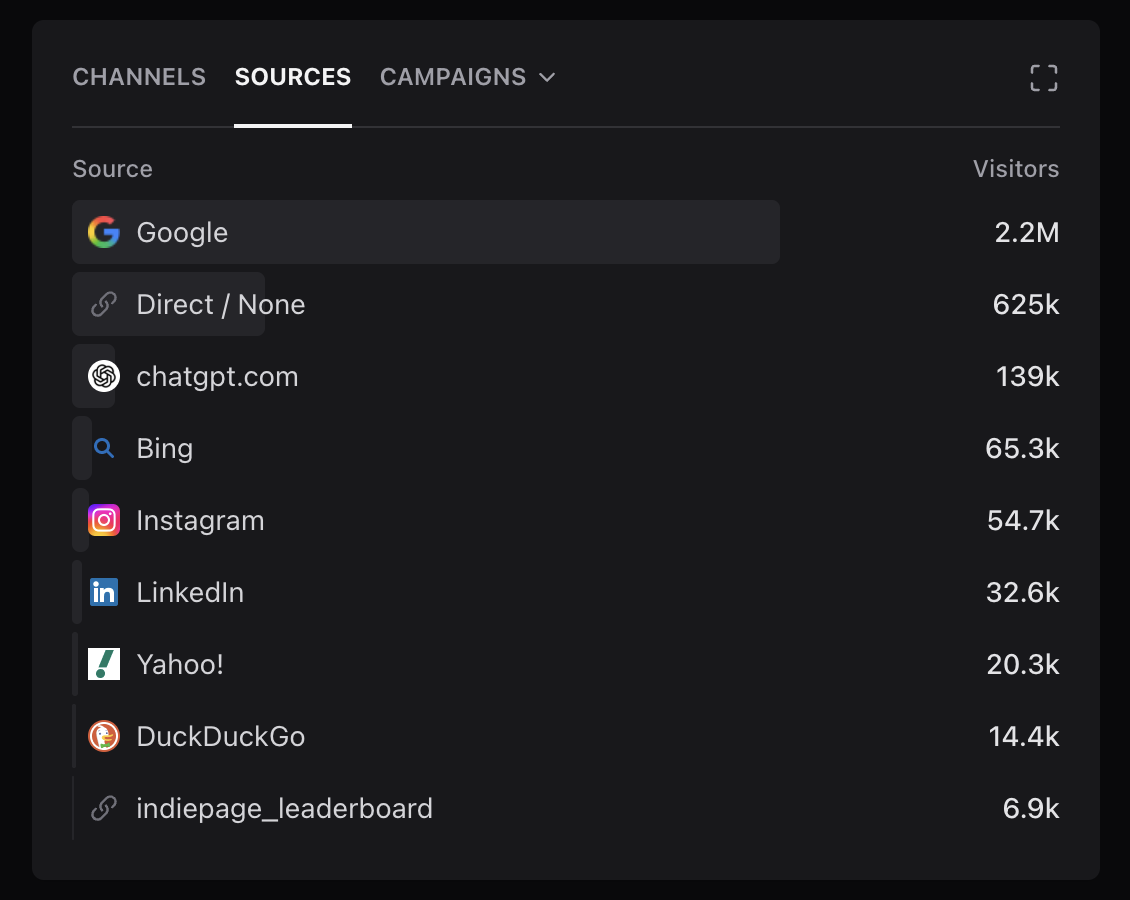
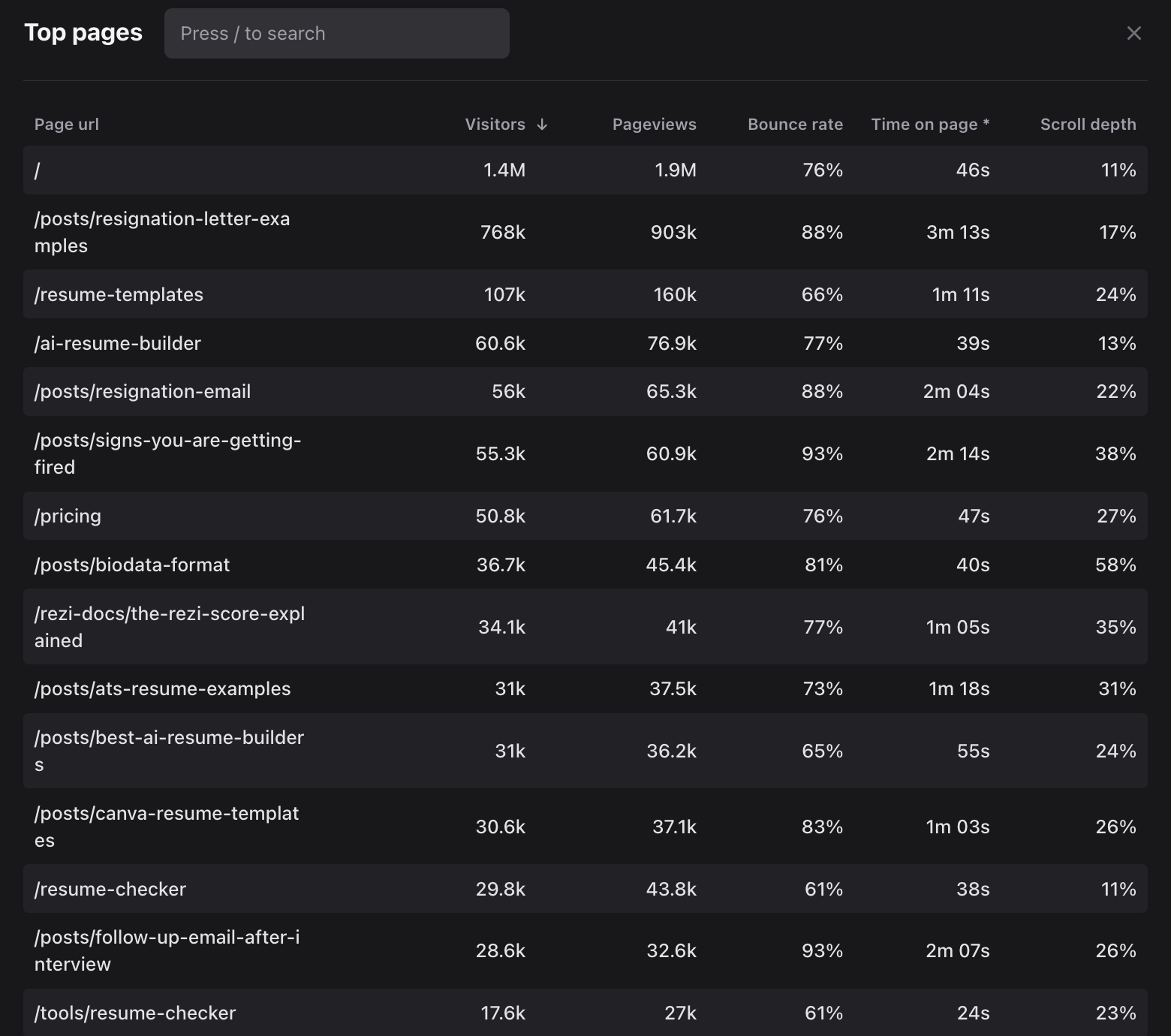
The metrics below for top pages indicates that users are spending time on the page and engaging with the content, not just bouncing immediately.
I’d like to add some extra thoughts here.
AI-generated answers can satisfy informational intent within the interface, contributing to a rise in zero-click searches. However, it’s reasonable to assume that the resulting traffic could be more commercially valuable because it represents a "qualified referral" from the AI.
When a user clicks through, they may have already gone through the awareness stage and entered an evaluation or solution-seeking phase. To capture this, your content strategy must prioritize topical authority and entity-based optimization, using structured data and "citable facts" that encourage LLMs to credit your brand as the definitive source when intent is strongest.
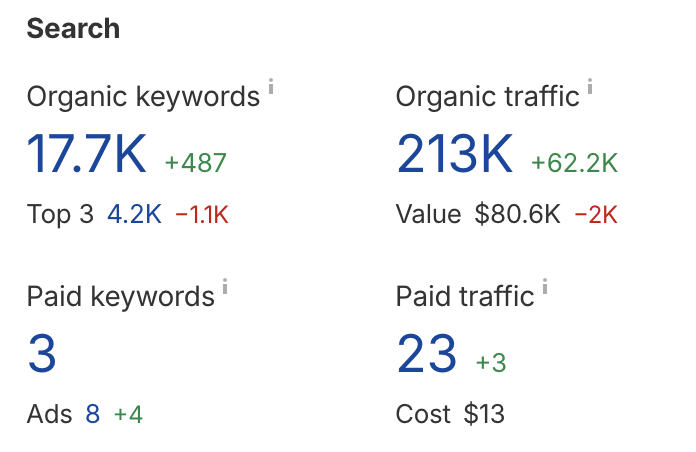
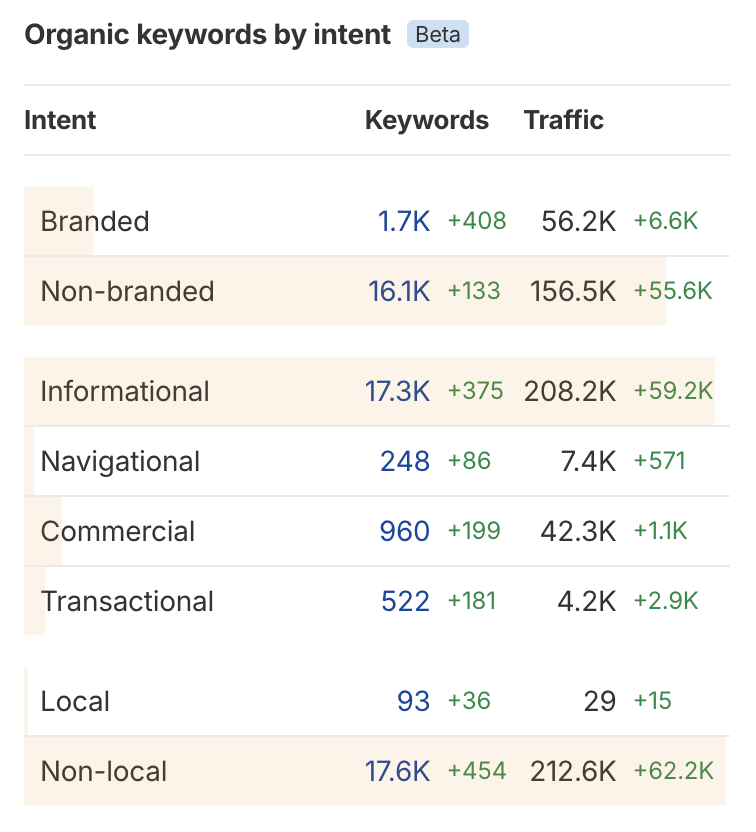
Ahrefs snapshot (December 2025)
What’s next?
Adapting to AI search wasn’t about completely reinventing the wheel. It was about raising raising the quality bar on what content needs to do to actually contribute to important outcomes: build trust, communicate product value, and influence real decisions.
A few more points I would urge anyone in SEO and content marketing to consider:
Better landing pages is crucial. However, website content will still be important for reinforcing topical authority.
Focus on content that isn’t easy to replicate and raise the quality bar. Double down on subject and product expertise, and find ways to be the source for new information or for a new angle on a relevant topic.
You have to double down on your core customer. AI search results are increasingly personalized, meaning the same prompt can give different users completely different answers based on their context and history. Optimizing for every possible variation isn’t realistic, but you can focus on making your brand the obvious answer for your specific ICP. Build your SEO and content strategy around their needs, their language, and the problems they're actually searching to solve.
Optimize for entity and consensus. SEO involves more than just what’s on your website.
And one final point: not everything in marketing is going to be measurable. There won’t always be clean attribution and more often than not, marketing works in silence. This LinkedIn post by Justina Perro, a fractional head of content, summarizes it nicely.
If you're a founder or marketer navigating AI search and have questions about how organic search can translate to user signups and revenue, feel free to reach out.
